Simple Steps to Kindness
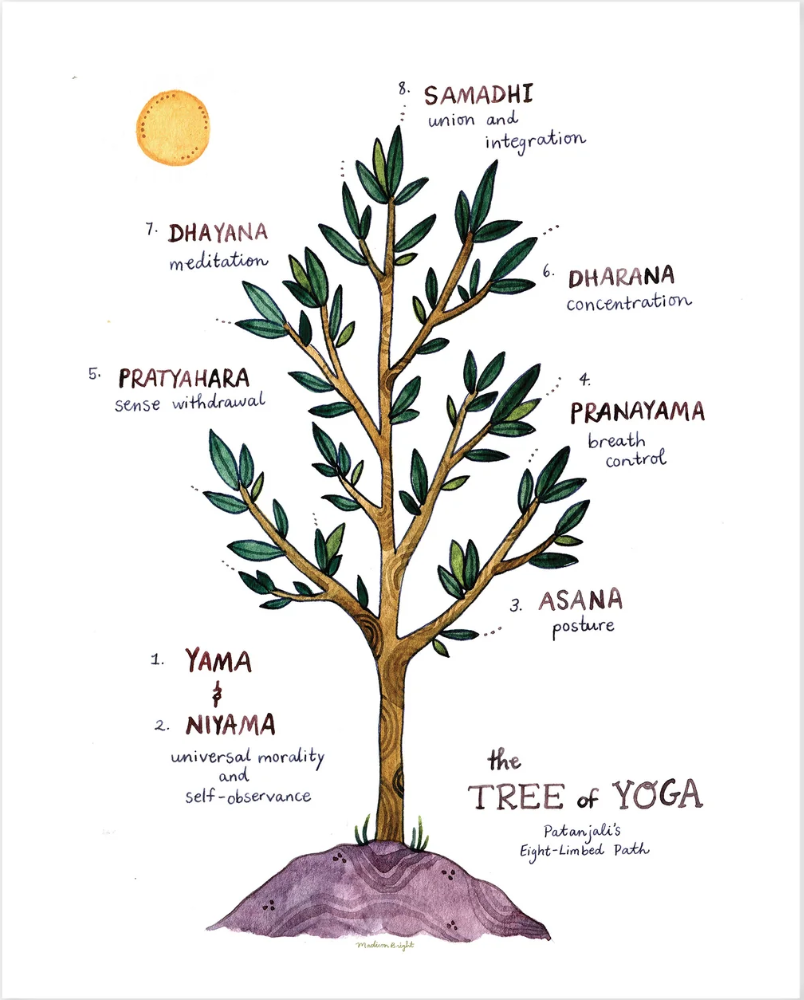
Above, image of: The Eight Limbs Model of Healing by Patanjali
In Yoga we follow The Eight Limbs Model of Healing as a guide toward inner clarity, health, vitality, and joy. It incorporates philosophy, physiology, and psychology all into one holistic practical practice. The first two steps in the Yoga Model of Healing are referred to as the Yamas and Niyamas, these are the personal attitudes, and social observances that we practice daily to help release self limiting beliefs and habitual behavioral patterns that we find ourselves stuck in (unconsciously or consciously). In eastern thought, non-violence (kindness) is so valued that it stands as the very core and foundation of all yoga philosophy, thought, and practice. It is known as ‘Ahimsa’ in yoga.
‘Himsa’ means ‘injustice’ or ‘cruelty’ the -a prefix suggests the absence of ‘Himsa’. Ahimsa in it’s totally means more than just a lack of violence, it refers to kindness, friendliness, and thoughtful consideration of other people and things. To practice Ahimsa daily means to behave with consideration and attention to others while remaining kind to ourselves. As an example, should we find ourselves as vegetarians and we are starving but all there is to eat is meat, is it better to stave to death than to eat what is there? If we still have something to accomplish in this life, such as family responsibilities, then we should avoid doing anything that may cause harm or prevent us from carrying out our duties. So Ahimsa has to do with our duties too - to even fight if our life is in danger.
Since Ahimsa also speaks to how we connect others, yoga philosophy teaches us that it would show lack of consideration and arrogance to become stuck on our own principles or thought. So it encourages us to adopt a considerate attitude towards other people and their truth in the moment. This does not mean to completely abandon our own values but instead to listen with an open heart and mind so we can fully receive what another is telling us. We will explore this concept more further on.
All of our achievements, successes, hopes, and joys stand on faulty ground if they do not stand on the foundation built by non-violence (kindness). We see this clearly by the consumerism of modern day society. Big corporations pushing foods, advertisements, activities, that cause harm directly or indirectly, all for greed and consumption. If we are to find true success and accomplishment in this life, we must ask ourselves if our actions, our purpose, is in loving service to all involved. If not, if our achievements only support us as an individual, what is the true quality of the success you are obtaining? Our inner strength and character determine our ability to be a person of peace at home and in the world.
There are 5 steps we can take in the pursuit of living a life guided by kindness:
Finding Courage
Creating Balance
Overcoming Powerlessness
Self-Love
Developing Compassion
The 5 steps work in chronological order but if we find ourselves particularly stuck on one step vs another, this is where our personal journey begins.
Step 1: Finding Courage
Fear is woven throughout the human experience. We see it expressed in avoidance, hostility, defensiveness, the need to control, the accumulation of possessions, and the walls we build around our hearts. If we look closely, many acts of greed, aggression, insecurity, and separation can be traced back to a common root: fear. Fear often lies beneath the behaviors that create suffering for ourselves and others. Understanding fear is therefore an essential part of practicing Ahimsa, the path of nonviolence and compassionate living.
To work skillfully with fear, we must first recognize that not all fear is the same. Some fears serve a valuable purpose. Instinctual fear is designed to protect us from genuine danger and support our survival. Other fears arise from uncertainty, unfamiliarity, or stories we have created about what might happen. While every person's fears are unique, they often share a common effect: they limit our ability to live freely and fully. Self-reflection helps us discern whether our fear is signaling a true threat or simply inviting us into unfamiliar territory.
Many of us become trapped in cycles of "what if" thinking, imagining countless ways a situation could go wrong. These mental patterns are often learned over time, shaped by childhood experiences, difficult life events, or beliefs we have carried for years. The unfamiliar then becomes associated with danger, even when no real threat exists. Yet it is often our perception, rather than reality itself, that creates the tension we feel in our minds and bodies. Fear can hold us hostage to imagined outcomes and prevent us from stepping into the possibilities that life is offering. One way to loosen its grip is to consciously imagine a different outcome—one rooted in growth, learning, and opportunity rather than failure or loss.
Ahimsa encourages us to cultivate courage by gently moving toward the people, experiences, and situations we might normally avoid. When approached with awareness and discernment, the unfamiliar becomes fertile ground for self-discovery. Every encounter has the potential to teach us something about ourselves and about life. Even those whose perspectives differ greatly from our own can help expand our understanding. As we become more willing to listen, learn, and remain open-hearted, our worldview broadens. The world becomes less threatening, our confidence grows, and we develop a greater capacity to navigate life's challenges with wisdom and compassion.
Creating a life rooted in nonviolence begins with the courage to face our own fears. Courage is not the absence of fear; it is the willingness to move forward even when fear is present. It is the ability to acknowledge uncertainty without allowing it to determine our choices. If we remain only within what is comfortable and familiar, our courage has little opportunity to develop. Growth occurs when we step beyond the boundaries of what we already know and trust ourselves enough to meet the unknown with an open heart.
Through courage, fear becomes a teacher rather than an obstacle. It reveals where we are being invited to grow, where we are being called to trust, and where greater freedom awaits. As our courage expands, so does our capacity for kindness, understanding, and nonviolence. In this way, courage is not only a personal act of transformation—it is also the first step to living in a more compassionate world.
Step 2: Creating Balance
Courage calls us to show up as our best selves, and that becomes much easier when we are living in balance. When our body, mind, or spirit falls out of harmony, that inner discomfort often finds a way to express itself outwardly. It may appear as impatience with loved ones, overcommitting ourselves, withdrawing from meaningful connections, or neglecting our own needs and responsibilities. What we experience internally inevitably influences how we move through the world. In contrast, when we cultivate balance within, our thoughts, words, and actions naturally become more harmonious as well.
Creating balance is not always simple. We live in a world filled with constant stimulation, endless responsibilities, and countless messages promising happiness, success, or fulfillment. It can be tempting to fill every available moment with work, activities, appointments, and obligations. Yet just as the body requires time to rest and recover, the mind and spirit need space to process, reflect, and integrate life's experiences. Balance is created when we intentionally make room to breathe, slow down, and reconnect with ourselves.
Consider your ideal vacation. Perhaps you imagine yourself at the beach, in the mountains, or at a beautiful resort surrounded by people you love. Notice not only where you are, but how you feel in that space. Most of us associate certain places with relaxation, but often it is not the location itself that creates peace. What truly restores us is the permission we give ourselves to slow down, be present, and let go of the demands of daily life. We may believe, "I can only relax at the beach," when in reality the beach simply provides the conditions that allow us to rest, breathe, and reconnect. Those same qualities can be cultivated wherever we are when we intentionally create space for them.
We all need moments to reflect, journal, process our experiences, dream, imagine, and listen deeply to ourselves. Balance grows when we learn to hear the quiet wisdom within. To access this inner guidance, we must create enough stillness to listen. Unlike the noise of the external world, this inner voice does not pressure, persuade, or make promises. It simply knows. It gently guides us toward what supports our health, vitality, and overall well-being. Across cultures and traditions, people have given this wisdom many names—intuition, subconscious awareness, Universal Consciousness, God, inner knowing, or gut instinct. Whatever name we choose, the truth remains the same: each of us possesses an inner guidance system that continually leads us toward harmony and wholeness.
In a culture that often celebrates busyness, spreading ourselves thin can appear productive or impressive. Yet when we consistently sacrifice our well-being, we are often the ones who pay the highest price. The effects may show up in our health, our relationships, our peace of mind, or our sense of purpose. Balance is not a luxury; it is a necessity for living well. When we care for the health of our body, mind, and spirit, we strengthen our ability to navigate life with greater resilience, clarity, and ease. From that place of balance, courage becomes more accessible, and our capacity for kindness—both toward ourselves and toward others—naturally expands.
Step 3: Overcoming Powerlessness
Feelings of powerlessness often give rise to frustration, anger, resentment, or withdrawal. At times, they can leave us feeling stuck, defeated, or unable to move forward. Powerlessness arises when we believe we have run out of options, lack the ability to handle what is in front of us, or feel overwhelmed by life's challenges. In these moments, the mind can become clouded by fear, anxiety, and self-doubt, making it difficult to see a way through. Ahimsa, the practice of nonviolence and kindness, invites us to question these feelings rather than accept them as truth. It reminds us that we always have a choice—whether that choice is to take action, seek support, learn a new skill, or challenge the story we are telling ourselves about our limitations.
One powerful way to move beyond feelings of helplessness is to ask,“What do I need right now to feel capable of handling this situation?” This simple question shifts our attention away from the problem and toward possibility. It encourages us to reconnect with our inner resources and recognize that growth often begins with a single step.
If the answer does not come easily, we can reflect on previous moments in our lives when we successfully navigated a challenge with courage, resilience, and self-respect. Remembering these experiences helps awaken the strength that already exists within us. If we still struggle to find clarity, we can continue our self-inquiry by asking, “What prevents me from responding to difficulty with kindness toward myself and others?” Through honest reflection, we begin to uncover the beliefs, fears, and habits that contribute to our suffering. As we gently follow these threads to their source, we create the opportunity for healing, growth, and a deeper understanding of ourselves.
Powerlessness is often rooted in an old story we have come to believe about ourselves—a story that may have been shaped by past experiences, childhood conditioning, or moments of hardship. Yet these stories are not permanent truths. Yoga teaches that every challenge contains an opportunity to strengthen our relationship with life. Difficult situations invite us to develop greater courage, balance, patience, compassion, and trust while remaining grounded in kindness toward ourselves and others.
When darkness, fear, or anxiety begin to take hold, three simple practices can help us reconnect to our inner strength:
Practice gratitude.
Trust the present moment.
Think about how you can serve or support the greater good for all.
These practices help shift our awareness from limitation to possibility, reminding us that we are never as powerless as we may feel. Through self-reflection, compassionate action, and a willingness to challenge old beliefs, we reclaim our ability to move forward with confidence, purpose, and kindness.
Step 4: Self-Love
Our ability to remain balanced and courageous is deeply connected to the relationship we have with ourselves. What we carry within is often what we share with the world around us. The attitudes, beliefs, and emotions we direct toward ourselves naturally shape the way we interact with others. If we are relentlessly disciplined with ourselves, others may feel the sharp end of that discipline. If we are highly critical of ourselves, that same high standard can unknowingly extend into our relationships. Yet when we offer ourselves patience, forgiveness, and understanding, others experience that same sense of ease in our presence. When we can laugh at our mistakes, delight in who we are, and embrace our humanity, we create a space where others feel accepted, supported, and at peace.
We would never buy a can of red paint and expect it to be blue, yet we often expect ourselves to live under harsh judgment while somehow remaining loving and compassionate toward others. The truth is that the way we treat ourselves becomes the foundation for how we treat the world. If we cannot create a sense of safety within ourselves, it becomes difficult to create safety for those around us. When we pause long enough to step back from the busyness of life, we begin to see how our habits and choices contribute to either harmony or turmoil. A life filled with constant activity, endless responsibilities, and little room for rest can leave us disconnected from ourselves and from the people we love. As we learn to slow down, reflect, and welcome more ease and enjoyment into our own lives, we often discover that our relationships become more meaningful, nourishing, and joyful as well.
One beautiful practice is to begin falling in love with yourself. Falling in love is a remarkable experience. We see beauty where we once saw flaws, we delight in simply being with the one we love, and we naturally extend grace where judgment once lived. Love softens expectations and makes room for spontaneity, joy, and wonder. It is expansive by nature, touching not only the one who loves but everyone around them. So consider the experiment. Treat yourself with the same care, attention, and affection that you so freely offer others. Give yourself what you often seek from the outside world. Spend time with yourself, celebrate yourself, and learn to appreciate the person who has been with you through every chapter of your life.
Many of us genuinely want to love others well, but the reality is that we often express love through the lens of how we love ourselves. At the heart of nonviolence lies self-love—not a self-centered love, but a compassionate and forgiving love. It is a love that embraces imperfections, finds humor in mistakes, and honors the fullness of the human experience. To love ourselves fully, we must also learn to forgive ourselves. Without forgiveness, guilt settles heavily on the heart, limiting our capacity to experience and share love freely. It binds us to unrealistic expectations and keeps us from embracing the richness and complexity of being human.
Courage and love are inseparable companions on the path of healing. As Swami Rama said, “When love became the Lord of my life, I became fearless.” Similarly, Jesus taught, “Perfect love casts out fear.” Love creates expansion where fear creates contraction. It opens the heart, nurtures compassion, and gives rise to the safety and belonging we seek. In its purest form, nonviolence is an expression of love. Love creates expansion and nonviolence and the true safety we seek. Nonviolence in its purest form is woven with love, and love of other is woven with love of self, the two are one.
Step 5: Developing Compassion
Compassion grows as we begin to soften our rigid ideas about ourselves, others, and the world around us. It develops when we are willing to see life as it truly is rather than through the lens of our assumptions, judgments, and expectations. We learn compassion when we step out of the stories we create in our minds and open ourselves to understanding experiences beyond our own. Rather than trying to control, change, or fix everything, compassion invites us to soften the boundaries that separate us from one another. It asks us to recognize that every life has value and that every person is carrying experiences we may never fully see. Through simple acts of kindness and thoughtful consideration, we begin to cultivate a deeper connection to the people and world around us.
At its core, compassion is a clear and heartfelt response to the needs of the present moment. It is more than sympathy or feeling sorry for someone. Compassion moves us to action. We see this reflected in the lives of great teachers, leaders, and stewards throughout history—individuals whose willingness to care so deeply for others, it inspired meaningful change. Their compassion was not passive; it was expressed through courageous action and a sincere desire to ease suffering wherever they encountered it.
The ancient Greek word splagchnizomai, offers a powerful insight into the nature of true compassion. The word literally refers to a deep stirring within one's inner being, a feeling so profound that it is experienced viscerally, in the very depths of the body. In the ancient world, emotions were understood not merely as thoughts or feelings of the heart but as powerful experiences that moved a person outwardly from within. Often translated as compassion in the teachings of Jesus. When this word was used, it described someone who was so deeply touched by another's suffering that they felt compelled to respond immediately. Compassion was understood as an inner movement that naturally gave rise to outward action.
In its truest form, compassion often asks us to move beyond our comfort zones and personal preferences. It encourages us to look beyond fear, judgment, and social divisions so that we can respond to the needs of others with humanity and care. We see this spirit embodied in first responders, healthcare professionals, caregivers, and countless individuals who place the well-being of others alongside their own. Their actions remind us that compassion is not simply a feeling; it is a willingness to show up when someone needs support, understanding, or kindness.
Most of us may never be called to run into a burning building or perform heroic acts of service. Yet every day offers opportunities to practice compassion in meaningful ways. We can listen more attentively, speak more kindly, forgive more readily, and approach others with greater patience and understanding. We can choose kindness even when fear, frustration, or judgment tempt us otherwise. In doing so, we strengthen our ability to meet life with an open heart.
Every person we encounter carries unseen joys, struggles, fears, and wounds. If we remembered this more often, we might view one another through the eyes of compassion rather than through the filters of our preconceived judgements and assumptions. Ahimsa, the yogic principle of nonviolence, invites us to walk gently through the world, striving to do no harm while honoring our interconnected relationship with all life. It asks us to treat ourselves, one another, and the Earth with respect, care, and understanding. Through compassion, we recognize that the well-being of others is deeply connected to our own, and that every act of kindness contributes to a more peaceful and loving world.
Conclusion
As we journey through the Five Steps to Kindness—finding courage, creating balance, overcoming powerlessness, cultivating self-love, and developing compassion—we begin to see that Ahimsa, or nonviolence, is far more than avoiding harm. It is a way of living that transforms our relationship with ourselves, others, and the world around us. Each step invites us to look inward with honesty and awareness, uncovering the fears, beliefs, habits, and wounds that keep us disconnected from our creations true intended nature- to love. Through courage, we learn to move beyond fear. Through balance, we create the space needed to hear inner wisdom. Through overcoming powerlessness, we reclaim our ability to respond to life with confidence and purpose. Through self-love, we cultivate the compassion and forgiveness that allow us to embrace our humanity. And through compassion, we recognize our shared connection with all beings and become willing to act with kindness on behalf to all.
The path of Ahimsa reminds us that peace in the world begins with peace within ourselves. Every thought, word, and action rooted in kindness becomes a contribution to the healing of the whole. As we continue to practice these principles, we discover that true strength is found not in control or perfection, but in an open heart. We learn to meet ourselves and others with greater understanding, patience, and love. In doing so, we become living expressions of nonviolence—walking gently through life, honoring the sacredness of all beings, and creating a world where compassion, courage, and joy can flourish. The journey begins with a single choice: to choose kindness, again and again, in every moment we are given.
